.tmb-hero_l.webp?Culture=en&sfvrsn=bc40030_1)
Renewable Energy and Electrical Infrastructure Upgrade
Overview
Rottnest Island Authority is responsible for generating and supplying electricity for Wadjemup / Rottnest Island. Based on modelling, the renewable energy and electrical infrastructure upgrade project will achieve an abatement of more than 4,000 tonnes of carbon emissions per year, which is equivalent to 900 cars removed from the road, which saves 1.5 million litres of diesel, reducing emissions per visitor from 4.9kg CO2 per visitor down to 1.8kg CO2 per visitor.
The renewable energy and electrical infrastructure upgrade will consist of:
- Solar
A more efficient 6MW solar system comprising of:- A new 3.2MW solar farm.
- Expanding capacity of the existing solar farm to 1.2MW
- 1.6MW of new rooftop solar on existing buildings
- Battery
- New 8MW/12MWh Battery Energy Storage System
- Wind
- Refurbishment of the existing 0.6MW wind turbine
- Power Station
- A new fuel efficient 5.6MW back up diesel power station. This will replace the existing 1962 diesel powerhouse and provide backup power when renewable generation is insufficient.
- Network Infrastructure
- Several new electrical kiosks
- High and low voltage cable
- Several new distribution boards
Environmental approvals process
RIA will be submitting the project to the relevant environmental authorities for formal environmental assessment under the Environmental Protection Act 1986. This is expected to include a Section 38 Referral, followed by a Section 51E clearing permit. Consultation with relevant stakeholders will form part of the environmental approval process.
The project is being designed and will be constructed with appropriate avoidance, mitigation and management measures to reduce environmental impacts where possible. The RIA are developing several management plans, which will be in place to support the project:
- Construction Environmental Management Plan (CEMP)
- Operational Environmental Management Plan (OEMP)
- Fauna Management Plan
- Dewatering Management Plan
These plans are not yet complete but will form a part of the formal submission to relevant authorities.
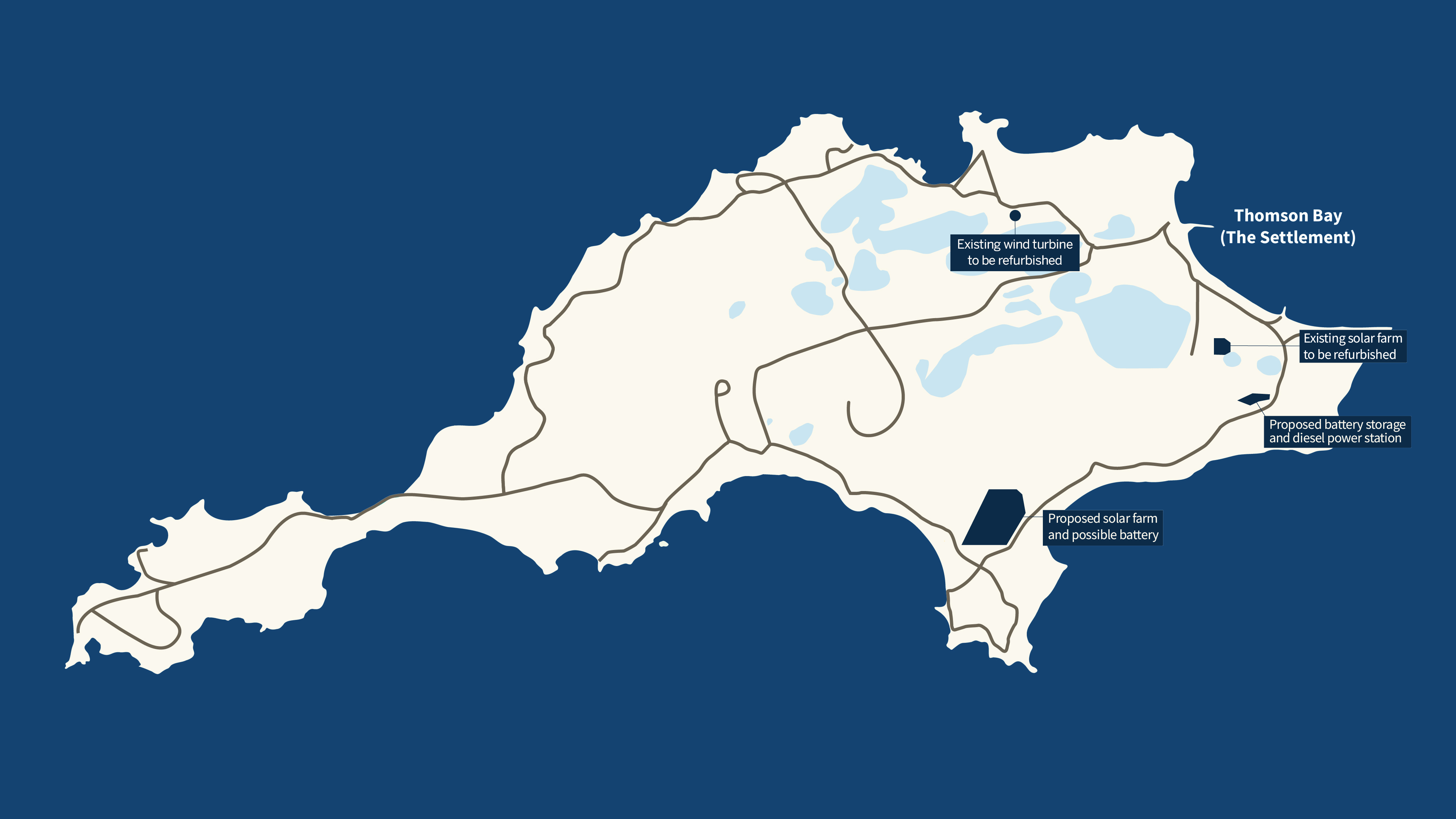
Location

Frequently Asked Questions
RIA will modernise and increase the capacity of the existing solar farm, install a new solar farm, install a Battery Energy Storage System (BESS), replace the old diesel power generators with modern versions and refurbish the existing wind turbine. In addition, new cabling to switching infrastructure to support this modern system.
To achieve 75% renewable energy, we need a new 3.2MW solar farm. The existing solar farm site cannot be expanded further, requiring RIA to identify a new site boundary within proximity to the power station for distribution.
As a key initiative of the Rottnest Island Management Plan 2023-28, the Renewable Energy and Infrastructure Upgrades will reduce the carbon emissions of the island. Economic modelling of generation determined a much higher proportion of renewables will produce a more sustainable and lowest cost outcome for the project.
The existing electrical infrastructure sites are constrained and there is limited capacity for expansion. The current power station, commissioned in 1962, is one of the oldest in the State.
A new power station is required because the current power station is not suitable for expansion to meet new renewable energy technology requirements. A new site has been identified that provides proximity to both the island's electricity distribution network and planned renewable energy infrastructure. The site is a largely cleared site next to the airport with minimal native vegetation, avoids Threatened Ecological Communities (TEC) and Environmentally Sensitive Areas (ESA), and no Aboriginal heritage sites have been identified. The site is largely unseen from nearby roads and removed from accommodation areas to avoid noise issues.
New wind power may be explored in the future, but for now it is not under consideration.
The aim is to implement this project and gain the benefits of more stable energy and significantly lower carbon emissions as soon as possible.
The project has already commenced with much of the network infrastructure completed and the refurbishment of the existing solar farm completed in early 2026. A new solar farm and power station construction will commence in 2027.
The new infrastructure for the project will be located on the southern side of the island. View these locations on the map.
The new power station site has been identified that provides proximity to distribution of electricity to the island, and proximity to renewable energy infrastructure. The site is a largely cleared site next to the airport. The site is largely unseen from nearby roads and removed from accommodation areas to avoid noise issues.
The site for the proposed new solar farm has been identified that provides proximity to the new power station and its battery storage. The site has sparse shrub vegetation and is predominantly a former dune blowout. The site is largely unseen from prominent lookouts, with limited visibility from nearby roads.
The site for the proposed new solar farm is designated 'Reserve' in the Rottnest Island Land Use Plan (LUP) within the RIMP. To enable development of the site as a solar farm, an amendment to the LUP is required to change the designation of the site from 'Reserve' to 'Infrastructure & Support Services'.
Numerous technical investigations have been completed to support the site selection, project development and environmental approvals including Aboriginal cultural heritage surveys, aviation impact, electromagnetic interference, fauna studies, geotechnical studies, military heritage, native vegetation and flora, noise impact and visual impact assessment.
The consultation period will be open for two months, closing at 5pm on Thursday 19 November 2026. Following this, all feedback will be reviewed, and a recommendation will be made to the Minister for Tourism to endorse the proposed changes. The final plan is expected to be completed in 2026.
The area within the project footprint has been surveyed and no Aboriginal cultural heritage sites or material has been found within this area. Consultation with Traditional Owners has been undertaken.
The land use for the project includes:
- New Power Station – 1 ha
- New Solar Farm – 14.5ha
- Network Infrastructure – 2.7 ha
In total 15.5ha of land will be permanently impacted for the new solar farm and new power station site combined (0.5ha already cleared) and 2.7ha temporarily impacted for new network infrastructure (cable routes).
Approximately 15 hectares of native vegetation will be permanently cleared to install project infrastructure. A further 0.55 hectares will be temporarily disturbed during construction and rehabilitated once the works are complete.
The project has been designed to use existing cleared areas, roads and tracks wherever possible. Horizontal directional drilling will also be used in some locations to avoid surface disturbance and reduce the amount of vegetation clearing required.
Construction and operational environmental management plans will be implemented to manage vegetation clearing, weed control, dust, fire risk and rehabilitation activities.
Environmental surveys found that the project will not directly impact threatened ecological communities, threatened flora species or priority plant species within the project development area.
The project area contains habitat for quokkas, Rottnest Island bobtails, Rottnest Island dugites, Perth sliders, and listed seabirds and shorebirds. Management measures will be implemented to minimise impacts on these species.
Environmental assessments estimate that quokkas may be displaced to nearby habitat during construction, representing less than 1% of the island's quokka population.
Measures will be put in place to minimise the risk of injury to quokkas and other wildlife. These include fauna management procedures, controls for construction activities, and measures to prevent animals from becoming trapped in excavations.
Project sites are not located within a Surface Water Management Area or Public Drinking Water Supply Area and will not directly impact the Rottnest Island Lakes, a Wetland of National Importance. Temporary dewatering may be required in some locations during construction, but any affected area is expected to be small and short term.
Measures will be implemented to manage sediment, erosion, spills and stormwater during construction. A Dewatering Management Plan and Construction Environmental Management Plan will guide these activities.
Assessments indicate that adverse impacts on groundwater-dependent ecosystems are unlikely due to the limited extent and short duration of any temporary groundwater drawdown. Similarly, the limited and short-term dewatering required for the project is unlikely to significantly impact the wetland.
There will be some light / noise emissions during construction and operations, however no unacceptable light or noise impacts are expected.
There is limited visibility (other than existing wind turbine) from key vantage points.
Contact and further information
Funding
.tmb-mediapanel.webp?Culture=en&sfvrsn=74bad0d0_1)
.tmb-mediapanel.webp?Culture=en&sfvrsn=b9fb97db_1)
.tmb-mediapanel.webp?Culture=en&sfvrsn=e5f359db_1)